
Status Report

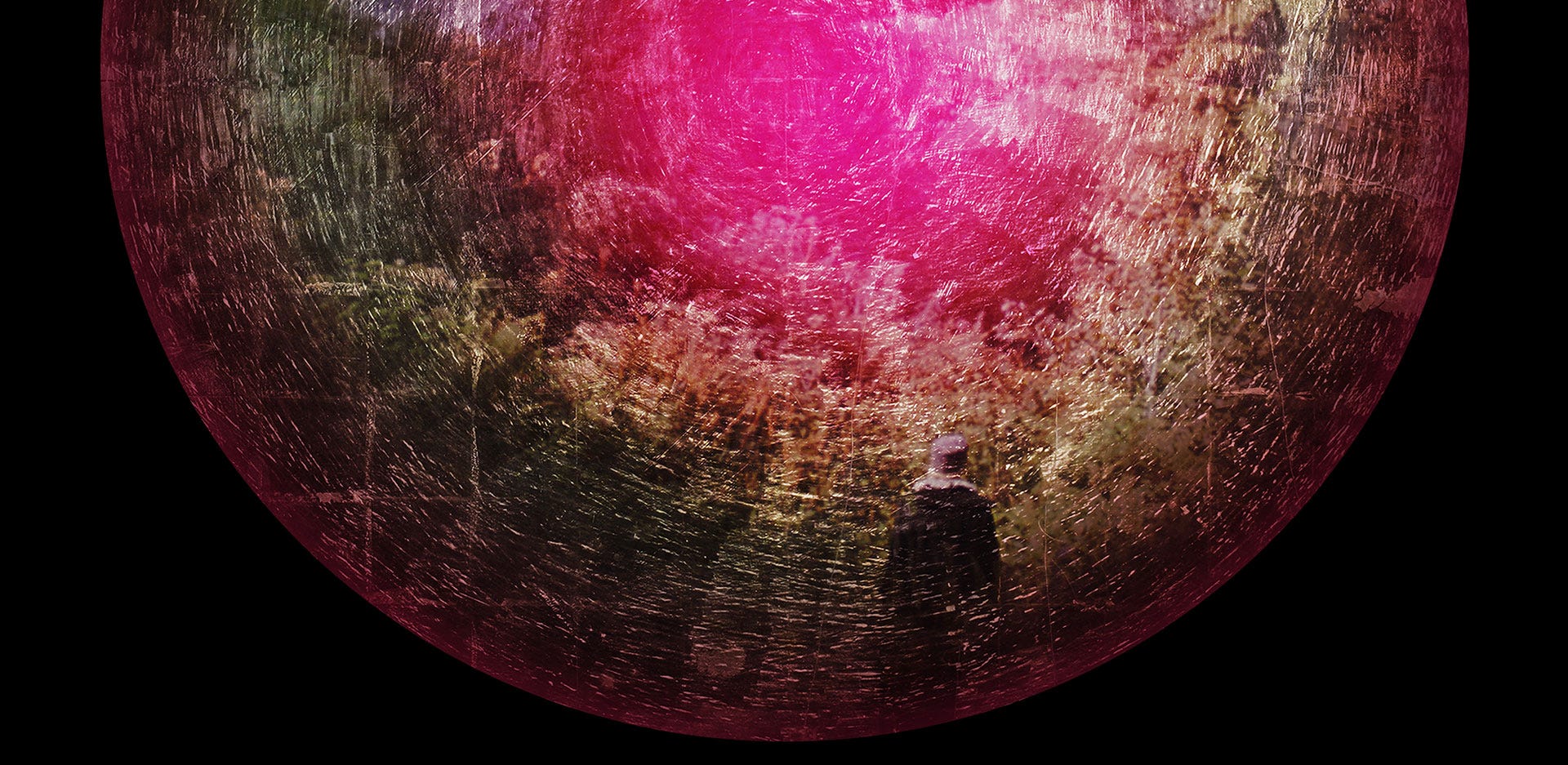
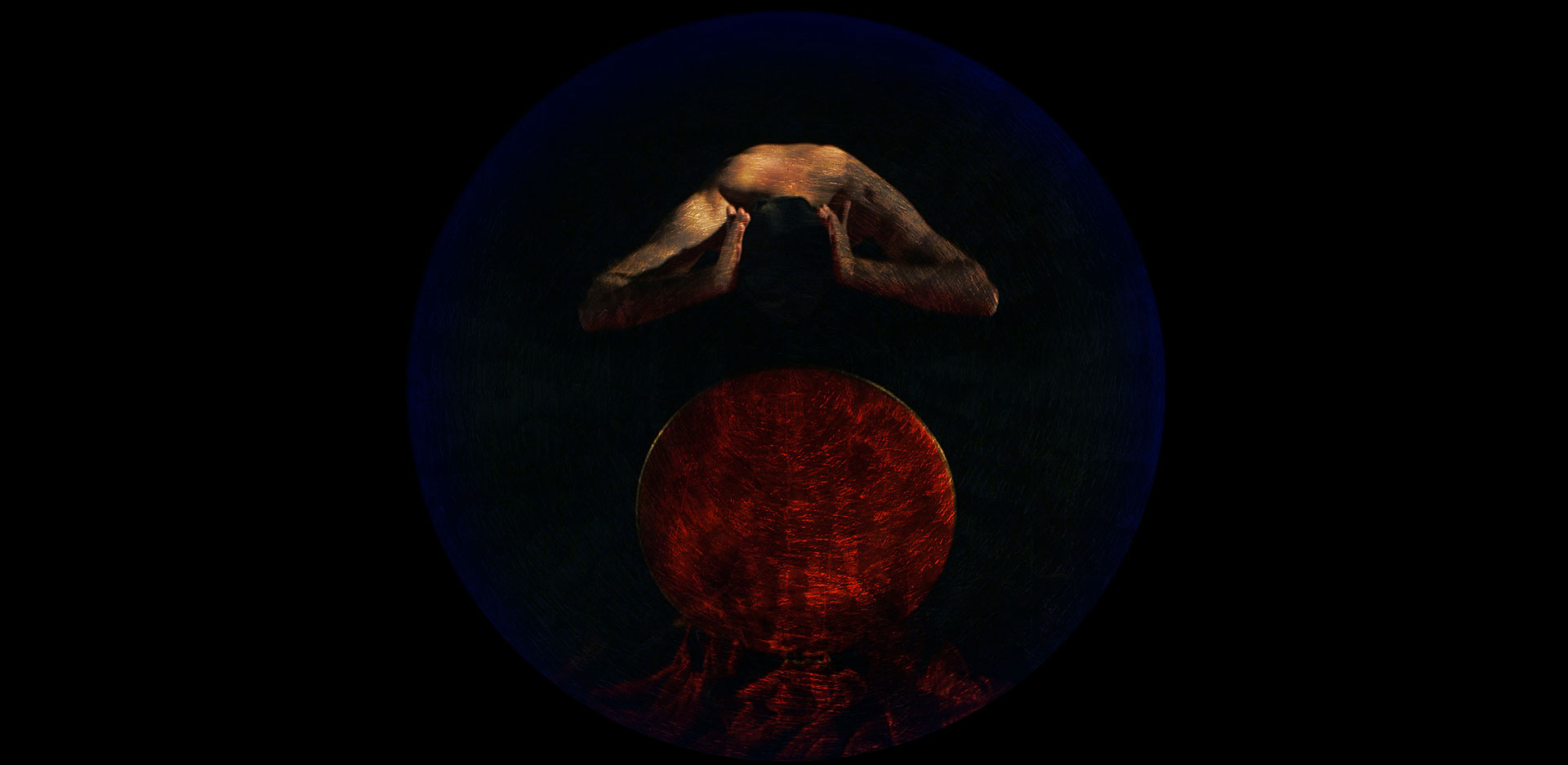
Almost three months have passed since I last posted here. In partial explanation, I’ve been working on a long post about a radical, almost unclassifiable film I saw in a private screening last summer. I don’t even know whether to call it a film, since part of its enchantment is the large (six feet in diameter), convex, gold-enameled wooden disk on which it’s projected: hence the project’s name, The Gold Projections. There are moments when the work seems less a film than an animated painting or series of paintings, as if one were moving through a gallery or rather standing in one while the paintings move slowly past or even unfold around one like the petals of a flower. The essay’s been hard to write. Ordinarily, I’d review the film several times to solidify my impressions and also to deepen and modify them, but The Gold Projections isn’t publicly available. There are no clips of it on YouTube: typing “Gold Projections” in the search bar gets you infomercials about the metal, which is becoming more valuable as the dollar becomes less so. The film’s rarity— its occultness— is another aspect of its enchantment.

At the same time, I’m working on the novel that’s occupied me on and off for ten years and on an essay called “Among Bad Patients” that was inspired by a recent stay in hospital. (I love writing “in hospital,” it’s so British. For years I’ve been trying to say “controversy” in the British manner, with the accent on the second syllable, but at every attempt I lose my nerve as I might when trying to dive off a high board and revert to standard American pronunciation, with an emphasis on the first syllable: “con.” A standard American word, trenchant to our moment.)
This is all to say that it will be at least a month before a new post appears, and probably more like two.
I’m also having doubts about this Substack’s usefulness, both to my readers and to me. A year or two ago I felt I could write about a singer or a movie or a novel with enthusiasm and moral confidence, the sense that it was possible to write about those subjects without slighting ones that were more important.
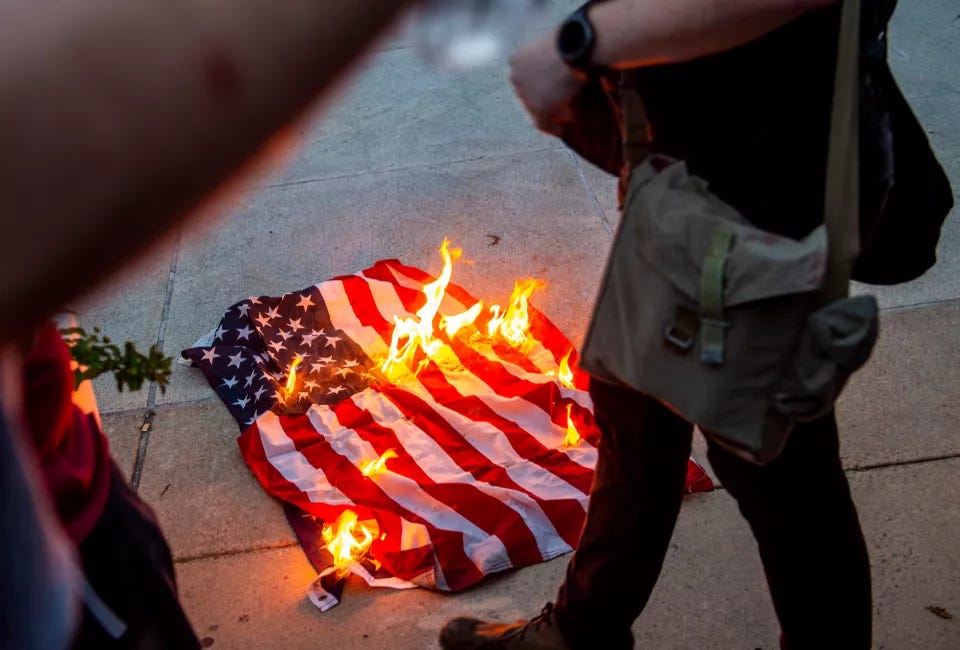
But now virtually the only subject I think about is the devastation of American democracy, of America itself: the gutting of its institutions; the casual brainless murder of its people, documented and undocumented; the mass kidnapping of those people, the imprisonment of those people in camps; the disempowerment and immiseration of supposed ‘minorities’ — people of color, women, queer and non-binary people— to mollify the resentments of the white men who actually are a minority and in fact a minority of a minority, considering the number of white men, this white man among them, who aren’t on board; the gloating impunity of the immiserators, down to the ones who rape children and the ones who say they didn’t know children were being raped and even if they had known a 15-year-old isn’t really a child.
Or maybe the true subject is the devastation of the beautiful, fecund, blameless, vulnerable world.

These are words. They cover the very wounds they point to.
I feel that this is what I ought to be writing about, but I’m too slow a writer to keep up the convulsions of a democracy that is either dying or preparing to come fully to life. And other writers are already saying what needs to be said about this suspended moment, notably Heather Cox Richardson Anne Applebaum, Joyce Vance, Virginia Heffernan, the folks at The Bulwark, and of course the mighty Rebecca Solnit. I’d add Greil Marcus, who doesn’t write about politics per se, but whose sense of American history and the interrupted dream of justice flows through his writings on American musics.
As much as I enjoy them and often admire their writers, most of the Substacks I read on other subjects have come to feel like evasions. Or maybe I’ve just become suspicious of anything that isn’t related to the emergency . I understand there’s something unhealthy about this, to say nothing of priggish. Many years ago a woman I was seeing met the aging father of one of my friends, who asked her what she did for work and when she told him, snapped, “I have absolutely no interest in that. The only thing I care about is spirituality.” He didn’t even preface it with “How nice.” I don’t want to be that guy.
The problem of writing about evil is that there’s so much of it, metastasizing with such speed and profusion, that any attempt at encompassing it risks becoming a rant. I just did that a few grafs up. My problem may be that I can’t bear to look at what I hate long enough to identify what about it makes me hate it and why you should hate it too . In the time I’ve been writing this Substack, I’ve only come close to succeeding a few times:
On rereading my old posts, I notice that even when I write to denounce something, I usually preface it with praise of something else. This is a sound practice, especially if you believe that evil isn’t a presence but an absence, a negation. I’m not sure I believe that. Still, I’m trying to find a way back to praise. I want to praise the beauty of the world and the measure that human beings contribute to it: Middlemarch and the band YHWH Nailgun and the live Thelonious Monk recording that I can’t find just now but that includes the audience’s shouts of joyful excitement. If you’d been in the room that night, you would have been shouting too. Anybody would have.
In an earlier draft, I continued with a long list of literature, music, movies, and visual art I’d like to write about, but it was too long. Between Middlemarch, YHWH Nailgun, and Thelonious Monk, you can figure out what I mean.
Because my main work of the next year will be finishing the novel, posts will continue to be infrequent. Those with paying subscriptions may want to pause or cancel. If you’ve taken out an annual one, let me know, and I’ll send you a refund.
Until then, here’s a paragraph I cut from the hospital essay. It’s probably my favorite one, and I cut it on the kill your darlings principle, though, like most principles, kill your darlings tolerates the occasional exception. And I cut the graf because by virtue of its surface heat, it would distract from the piece’s true center, which is the judgment placed on sickness and sick people in an overstrained healthcare system:
The one thing I miss about junk is the feeling of safety it gave me, as if I were being lowered into a missile silo beneath a frozen prairie, the elevator sinking slowly underground until it brought me to a place of absolute, cloistered stillness. You know the song that goes, Where the rain never falls and the sun never shines. How do I reconcile that feeling with all the times I got hurt?
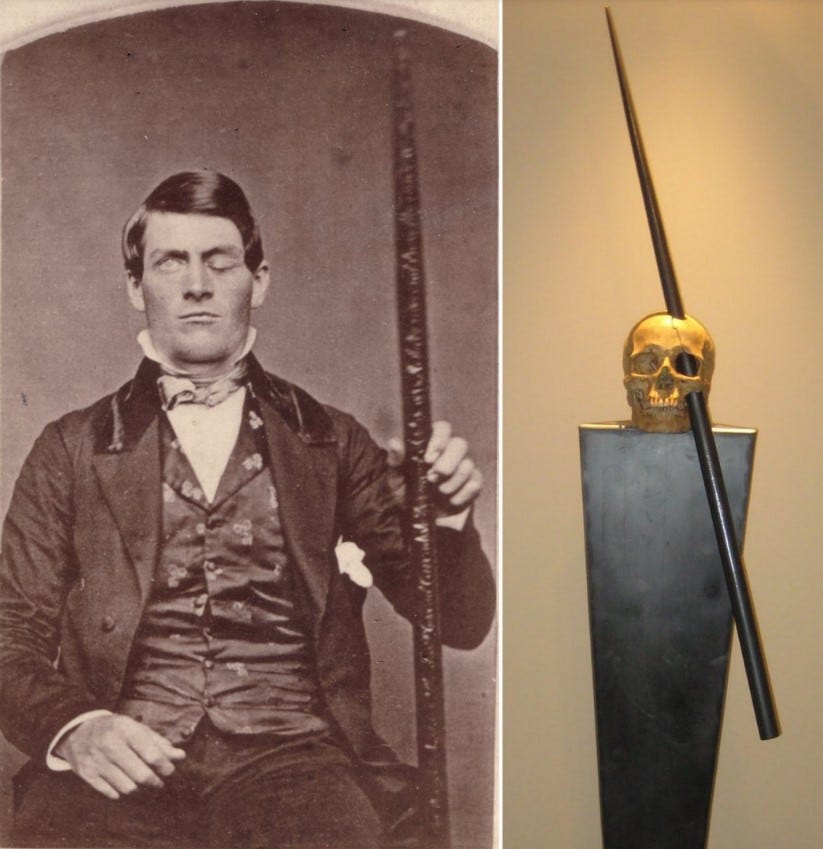
The image at the top of this post is a photograph of Phineas Gage (1823-1860), a railroad construction foreman who, while supervising work on the Rutland and Burlington in 1848, accidentally set off an explosion that blew a three-foot-long iron tamping iron through his head. According to John Harlow, the physician who tended to him at the site, [The tamping iron] entered the cranium, passing through the anterior left lobe of the cerebrum, and made its exit in the medial line, at the junction of the coronal and sagittal sutures, lacerating the longitudinal sinus, fracturing the parietal and frontal bones extensively, breaking up considerable portions of the brain, and protruding the globe of the left eye from its socket, by nearly half its diameter.
Miraculously, Gage survived, but over time he is said to have undergone gross changes of personality. Per Harlow, He is fitful, irreverent, indulging at times in the grossest profanity (which was not previously his custom), manifesting but little deference for his fellows, impatient of restraint of advice when it conflicts with his desires, at times pertinaciously obstinent, yet capricious and vacillating, devising many plans of future operation, which are no sooner arranged than they are abandoned in turn for others appearing more feasible. In this regard, his mind was radically changed, so decidedly that his friends and acquaintances said he was ‘no longer Gage’.
I often feel that I’m living in an America that has had an iron bar blown through its head. Or maybe that poor, maimed sonofabitch is me.
Good to hear from you. Always and whenever.
Hi Peter. Just wondering if you really are too slow or writer or if rather you are a human being frozen by the trauma of what you’re witnessing/experiencing. The unspeakable is a language of one word, after all.